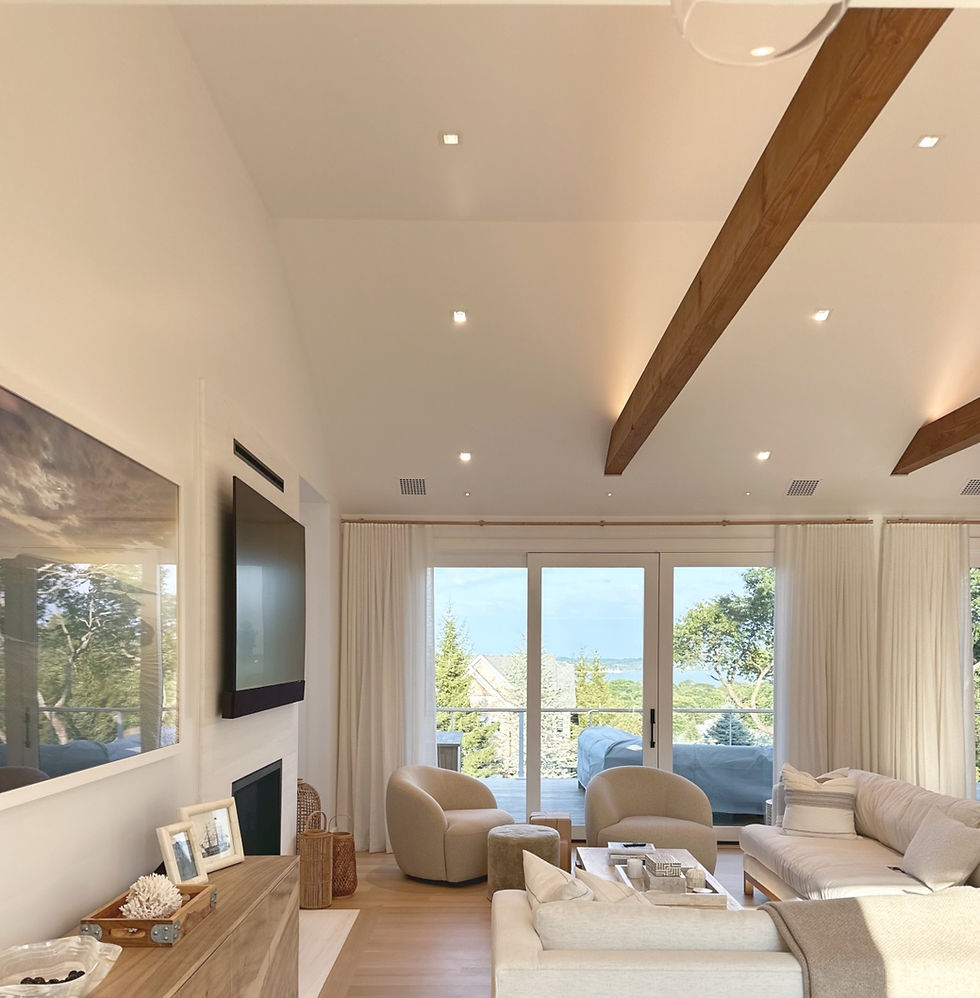
Lighting Can Make or Break a Fine Space — and Many Homes Get It Completely Wrong
After three decades designing and controlling light in exceptional homes, one truth remains constant: no finish material, no architectural detail, no view will save a room with bad lighting.
Walk into any truly extraordinary home and you feel it before you see it. There's a warmth and dimension to the space — shadows that behave, surfaces that glow rather than glare, a sense that every fixture belongs exactly where it is. That isn't luck. That isn't the architect. That is a lighting design executed by someone who has spent decades understanding how light moves, how it ages over the course of a day, and how it responds to control. At Bri-Tech, that work is what we've been doing for over thirty years.
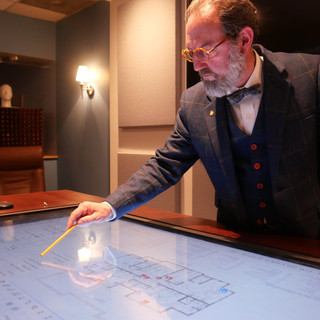
We say this not to dismiss the industry trend of AV companies suddenly offering lighting services — but to be honest with you about what experience actually buys. When our CEO walked the factory floor of our primary lighting manufacturer, he wasn't there for a sales pitch. He was there to understand dimming curve behavior, thermal performance at full trim, how a driver handles low-end flicker, and why two fixtures with the same specification sheet can render skin tone completely differently. That knowledge lives in the work, and it shows in the result.
"
A gang of plastic toggle switches in a hallway of your fine home is the equivalent of a vinyl floor in a $10 million kitchen. The technology of the room must match the ambition of the room."
— Bri-Tech Lighting Design Philosophy
Your Switches Are Undermining Your Home
This is a conversation we have constantly with clients who have invested heavily in stone, millwork, cabinetry, and hardware — and then left the lighting interface to whoever wired the house. The result is rows of commodity dimmers, mismatched plates, and zero intelligence connecting one room to another. In a space designed with intention, that is a fundamental contradiction.
Lighting control is not a convenience feature. It is the grammar of your space. The difference between a keypad that speaks to every zone in your home and a bank of individual dimmers is the difference between conducting an orchestra and pressing random keys. With a properly designed Lutron or Crestron-integrated control system, every scene — morning, entertaining, candlelit dinner, security away mode — is recalled in a single touch, from any surface, any device, anywhere in the world.

What "Knowing Lighting" Actually Means
The vast majority of lighting conversations in luxury residential work stop at fixture selection. We start there, but we don't stop there. Dimming behavior is one of the most misunderstood technical factors in residential lighting. A fixture that dims beautifully from 100% to 40% and then abruptly drops out is not a dimmed fixture — it's a fixture that fails you the moment you need nuance. We specify drivers and controls together because they are inseparable.
Color temperature is equally critical, and far more complex than Kelvin ratings suggest. The same 2700K label on two different LED sources can read completely differently when bounced off warm stone versus white plaster versus dark wood. We understand how finishes interact with spectrum. We spec accordingly — and we commission in the room, not in the showroom.

This Is Not a New Service for Us
When AV companies began adding lighting to their portfolios in recent years, we understood the market logic. Lighting control and home automation share infrastructure — it makes commercial sense to bundle them. But there is a meaningful difference between a company that has grown into lighting and one that was built around it. We have direct manufacturer relationships developed over three decades. We hold pricing structures and product access that come only from long-term partnership, not from a recent dealer application.
And when our principals visit factories — not trade shows, not showrooms, but the actual production line — the knowledge that comes back from that trip informs every project that follows. Which products are built for long term value, servicability and quality. Which ones have consistency over time. Which driver pairings create interference in neighboring low-voltage systems. This is the kind of institutional knowledge that cannot be acquired in a product catalog or a manufacturer's webinar. It is earned through years of designing, installing, and living with the results.
Our Symbiant platform — Bri-Tech's proprietary smart home system built on Crestron hardware with a perpetual client license and twenty years of development behind it — brings lighting into full conversation with climate, shading, security, audio, and video. The result is not a home full of apps and widgets. It is a home that behaves the way you want it to behave, without negotiation.
Ready to Design Light the Right Way?
Bri-Tech serves exceptional homes across Long Island and the greater New York region. Let's talk about your project before the first fixture is spec'd — that's when lighting decisions matter most.