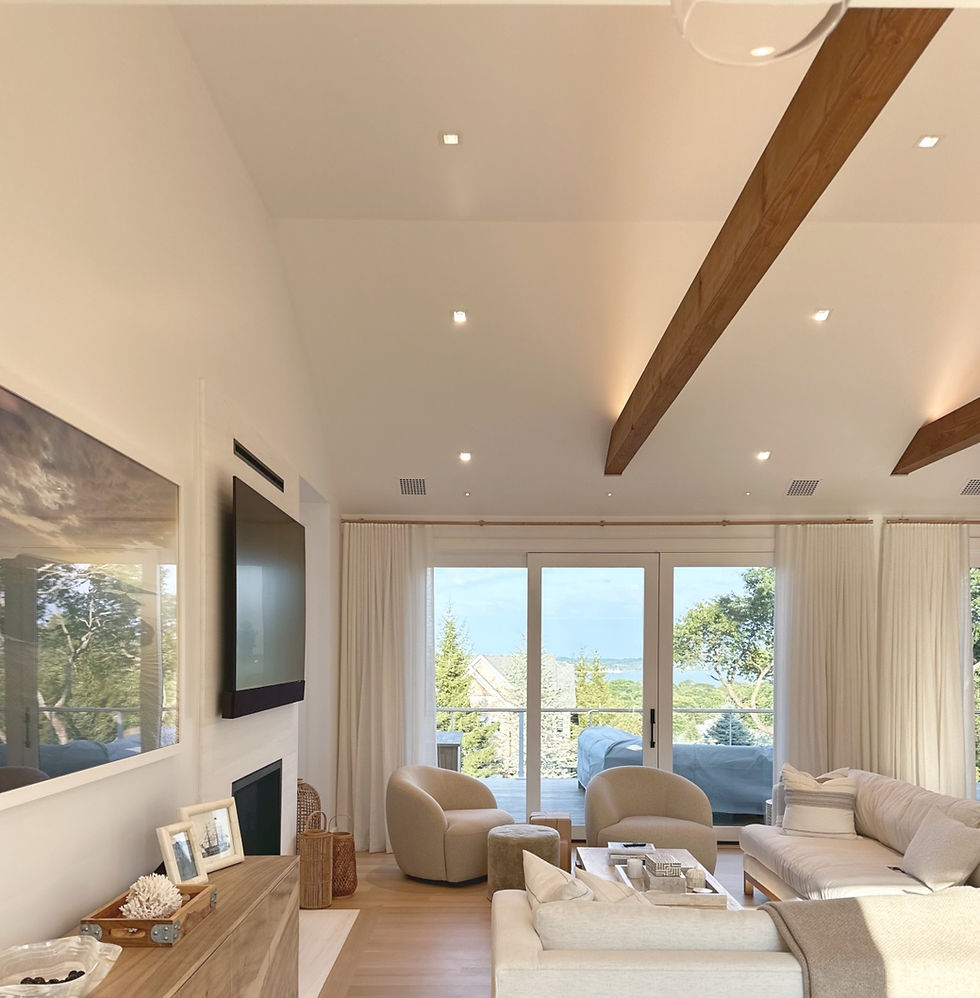
Why Acoustics Treatments Are Becoming Essential in Schools and Public Spaces

Walk into a busy cafeteria, a gymnasium doubling as an assembly hall, or an open-plan cyber lab, and you will notice the sound before you notice anything else. Voices stack on top of each other. A teacher near the back of the room sounds like she is speaking through a wall. A presenter at a town hall meeting gets asked to repeat themselves for the third time. None of that is an accident of the room. It is physics, and it is fixable.
The problem is bigger than an annoyance
Poor acoustics are not just an inconvenience. In classrooms, they directly affect how well students learn. The World Health Organization has identified noise as a measurable factor in cognitive load, attention, and even cardiovascular stress, and children are more vulnerable to it than adults because their brains are still developing the ability to filter competing sound. A room with a long reverberation time and high background noise makes speech harder to understand, which means students spend more effort decoding words and less effort learning the material behind them.
That is exactly what ANSI/ASA S12.60, the governing U.S. standard for classroom acoustics, was written to address. It sets specific limits on reverberation time and background noise levels for learning spaces, and while it is not a federal mandate everywhere, it shows up more and more often in state building codes and district design specs. It gives architects, facilities directors, and integrators a concrete target to design against instead of a vague sense that "the room sounds bad."
The scale of the issue is showing up in the numbers, too. The global market for acoustic treatment is on a steady upward trajectory, with most industry forecasts putting growth in the range of 6.5 to 7 percent a year through the early 2030s, and education is called out specifically as one of the segments driving that growth. It is not a niche concern. It is a design requirement that more owners are starting to budget for.
Why this is the right moment for schools and public buildings
Here is what makes this more than an academic conversation right now: school construction spending just hit roughly $89 billion this fiscal year, the highest level in the nation's history, and a large share of it is renovation, not new construction. HVAC modernization is the single biggest driver of that renovation work, with close to a third of the country's school buildings needing a system replacement or major upgrade. Every time a mechanical system changes, the acoustic profile of the room changes with it, which makes this exactly the moment when acoustic treatment should be part of the conversation rather than an afterthought bolted on later.
The same logic applies beyond K-12. Libraries, municipal buildings, performance venues, and transit facilities are all public spaces where people need to hear each other clearly, and where poor acoustics quietly undermine the purpose of the building itself. A library that hums with HVAC noise and hard-surface echo cannot function as a quiet study space no matter how good the collection is. A boardroom or auditorium that swallows speech defeats the purpose of gathering people in the first place.
Bri-Tech has been solving acoustic problems for decades
This is not new territory for us. Bri-Tech has spent decades designing and installing AV, low-voltage, and acoustic systems in schools, performance venues, and commercial buildings across Long Island, and acoustic treatment has always been part of that work. We understand how a room's acoustic performance interacts with the AV systems, the HVAC, and the way the space actually gets used day to day, because we have been the team responsible for making all of those pieces work together.
What sets us apart is that we are not limited to installing what someone else manufactured. Through our design-to-manufacture capability, we design and build acoustic products in-house, which means we can adapt a solution to a specific room instead of forcing a room to accept an off-the-shelf product that does not quite fit.

Introducing Aethon
That capability is now available as its own product line: Aethon, from Inspirence, Bri-Tech's acoustic environments division. The name comes from the aether, the intangible upper atmosphere of classical philosophy, which captures what good acoustic treatment should feel like: invisible and effortless. You should never have to think about it.
Aethon spans three categories, engineered from the start to help a space meet ANSI S12.60 reverberation targets, and every product in the line is built and assembled on Long Island.
Ceiling baffles handle broadband absorption without closing a room down. The Vertical Drop Baffle and Dual-Sided Cloud Baffle reach NRC ratings up to 1.00 with minimal ceiling intrusion, while the configurable Fin Baffle Array brings architectural rhythm to long corridors and open cyber labs while it works.
Acoustic panels cover the range from general-purpose absorption to problems most fabric panels cannot touch. The Fabric Wrapped Panel is the workhorse for classrooms and conference rooms, satisfying ANSI S12.60 directly. The Diffusion-Absorption Panel scatters sound instead of just soaking it up, for spaces like theaters and immersive environments where pure absorption would feel dead. The Bass Trap Corner Panel targets the low frequencies, the 125 Hz room modes, that fabric panels simply cannot absorb.
Acoustic wall systems turn a full wall into a finished acoustic surface, from the budget-friendly, peel-and-stick Modular Wall Tile System to the Perforated Metal Acoustic Wall built for gymnasiums and high-traffic corridors, the Slatted Wood Acoustic Wall for spaces where natural materials and Class A fire rating both matter, and the Stretched Fabric Wall System, which can double as a fixed projection surface or a full-color printed graphic on the same acoustically transparent track.
Let's talk about your space
If your school, district, or facility has a room where people struggle to hear each other, whether it is a classroom overdue for an HVAC upgrade, a gymnasium that doubles as an assembly hall, or a public building where meetings run long because no one can hear the person at the end of the table, that is a solvable problem, and it is one we have been solving for a long time.
Reach out to Bri-Tech to talk through your space and get a recommendation built around how the room is actually used. We will walk the site, measure what is really happening acoustically, and match it to the right Aethon products, whether that is one classroom or a full building renovation.
Design contact: Bri-Tech: 631-563-8000 | bri-tech.com | 829 Lincoln Ave, Bohemia, NY 11716
On Contract for purchase: Young Equipment | 631-582-5900 | info@youngequipment.com
11788